What are Data Brokers? Definition, Types, and how to Stop them
Interested in knowing more about data brokers? You are in the right place. Check out these resources:
- Incogni’s data broker opt out guides
- The best data removal tools
- Data brokers covered by Incogni (list)
- Data brokers lobbying
- Data brokers data breaches
What is a data broker?
A data broker is a company that earns money by dealing in your personal information.
They collect, organize, and analyze all the personal data they can find to build a detailed profile about you.
This profile is then sold for profit.
Companies buy it for marketing, organizations use it to reach certain audiences, and individuals can purchase it to find out more about someone.
Some data brokers operate openly, like the people search sites you can find on Google, but most of them work behind the scenes.
Examples of data brokers
Recently, the Federal Trade Commission (FTC) has labeled Facebook and Google as ”de facto data brokers”.
They might not fit the traditional definition perfectly, but their use of your data for advertising is seen as brokering.
Here are some other examples of data brokers:
- Experian isn’t only a credit bureau but also a huge data broker, with details on over 300 million people.
- Equifax, long with handling credit, gathers personal info and holds data on more than 220 million people.
- Epsilon holds records on over 250 million people.
- Acxiom tracks the info of more than 260 million people.
But that’s just the tip of the iceberg.
There are 500+ data brokers registered in California alone.
What kinds of data brokers are there?
There are various kinds of data brokers, each focused on specific areas. The most popular are people search sites, where you can look up anyone. Some brokers deal only with marketing or medical information.
Here are the main categories of data brokers:
- People search sites let individuals look up information about others—just enter someone’s name, pay a small fee, and you can access details like names, addresses, or even criminal and health records. If you’re in the US, you’ve probably come across these sites before.
- Marketing data brokers are used by businesses to buy information for their marketing efforts. Those spam calls, emails, and texts you get about new products or services are because companies bought your contact details from these brokers.
- Risk mitigation data brokers are used by insurance and credit companies to assess the risk of working with you. This data helps them decide things like your insurance rates or whether you get approved for a loan.
- Recruitment data brokers are used by companies to check out potential job candidates. They gather background information so employers can see if someone is a good fit for the position.
But that’s just a small part of the data broker landscape.
Nowadays, many brokers don’t stick to just one niche. Instead, they collect a wide range of data, including your online habits, interests, and even your criminal history.
The personal and sensitive information that data brokers collect can include:
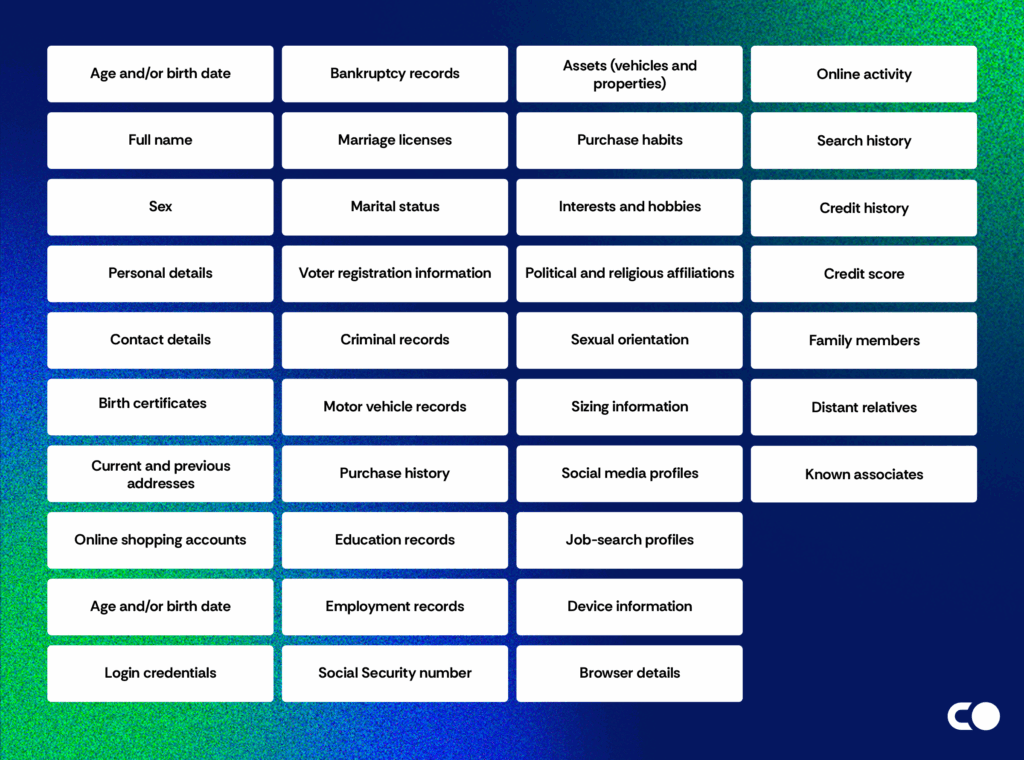
Think that’s enough? Unfortunately, the list doesn’t stop here.
Brokers can even track details about your houses, like their history, value, and when they were built.
The more they know about you, the more money they can make.
How do data brokers get your personal information?
Officially? From public records.
Unofficially? Well, there’s a lot more happening behind the scenes.
Here are some of the common methods data brokers use to obtain personal information:
- Online tracking: Data brokers track what you do online using cookies, pixels, and other tools that are part of websites, apps, and ads.
- Public records: They pull information from public sources like government records, property files, court documents, and professional licenses.
- Data suppliers: They buy data from other companies, including social media sites, online stores, loyalty programs, and data marketplaces.
- Surveys and forms: Data brokers might collect information through online surveys, forms, or contests, usually with your consent, though how well you’re informed about this can vary.
- Offline sources: They also get data from offline sources such as magazine subscriptions, loyalty programs, public events, surveys, and phone directories.
- Partnerships: Data brokers team up with other companies to share or buy data.
Keep in mind that data brokers use different methods to collect information, and their practices can bring up legal and privacy concerns.
Are data brokers legal?
Most data brokers operate within legal boundaries, and their practices are often regulated by data privacy laws.
In the EU, the General Data Protection Regulation (GDPR) sets strict rules, but the US lacks a similar federal law. Instead, there are state laws like the California Consumer Privacy Act (CCPA) and Colorado Privacy Act (CPA).
While the Federal Trade Commission can step in for serious data misuse, there’s no overarching federal data protection law yet.
How to limit the damage that data brokers can do to you
Opt out from broker databases.
If you’re an EU citizen, the GDPR obliges every data broker to delete your records whenever you ask them.
If you’re from the US, however, brokers may put up a little fight.
Here’s how you can remove yourself from data brokers:
- Opt out manually—it won’t cost you a dime, but it’s pretty time-consuming.
You’ll need to opt out from each data broker one by one. There are hundreds of people search sites alone, and many brokers aren’t even on the radar.
If you’re up for the challenge, here’s a list of data broker opt-out guides. - Opt out with a removal service—it isn’t free, but it offers peace of mind.
These services handle the removal requests for you, sending them to hundreds of data brokers regularly to ensure your information doesn’t reappear. You get a subscription and let the pros do the hard work for you.
If you want to opt out from data brokers with just a few clicks, check out Incogni.