TruthFinder Opt Out & Data Removal Guide
TruthFinder is one of the most popular people search sites on the web. If you’re concerned about strangers gaining access to your personal information, it’s definitely a good idea to opt out.
The opt-out process is handled by PeopleConnect and should be short and easy (if a little particular). Once you opt out from there, you’ll be automatically opted out from all of the people search sites owned by them.

Updated on: 04 August, 2026
Opt-out process:
10–15 minutes
Removal time:
about 48 hours
Requirements:
a valid email, your legal name, date of birth, and access to an email or phone number on your record
Cost:
free
This guide is part of Incogni’s free educational resources.
Some data brokers and people search sites need a manual push—Incogni’s custom removals are unlimited, so you can submit as many pages as you want and have your personal info cleared.
🛡️ 30-day money-back guarantee
How to opt out of TruthFinder step by step
Two things before you start:
The process has an identity-verification code near the end, so it takes a little longer than most opt-outs.
And opting out is not the same as canceling a TruthFinder subscription. More on both below.
-
Go to the TruthFinder suppression page
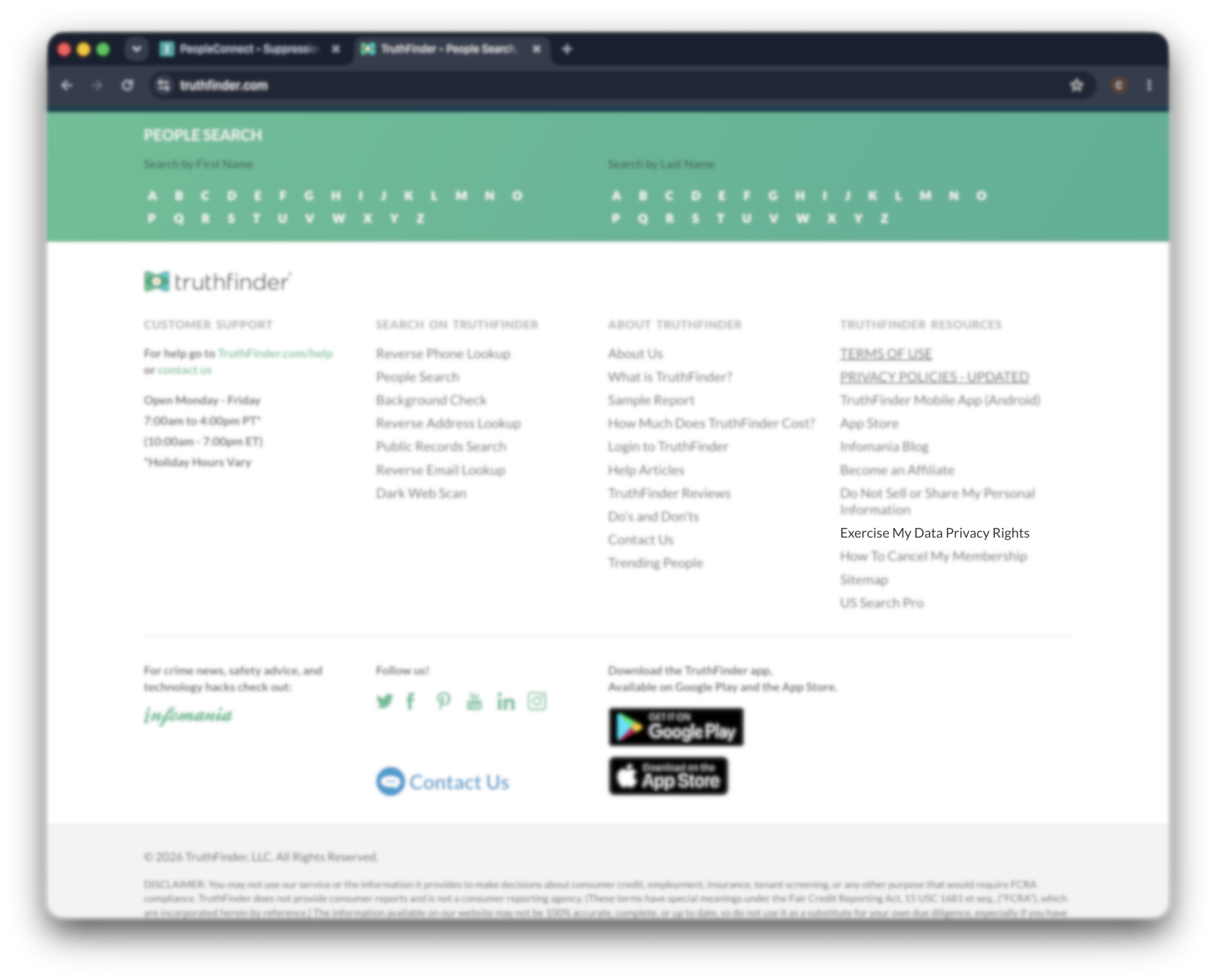
Open the PeopleConnect Suppression Center at suppression.peopleconnect.us.
You can also reach it from truthfinder.com—scroll to the footer and click “exercise my data privacy rights,” which routes you to the same tool.
Don’t try to opt out from a search result. The homepage is built to sell you a report. The Suppression Center is where removal actually happens.
-
Verify your email
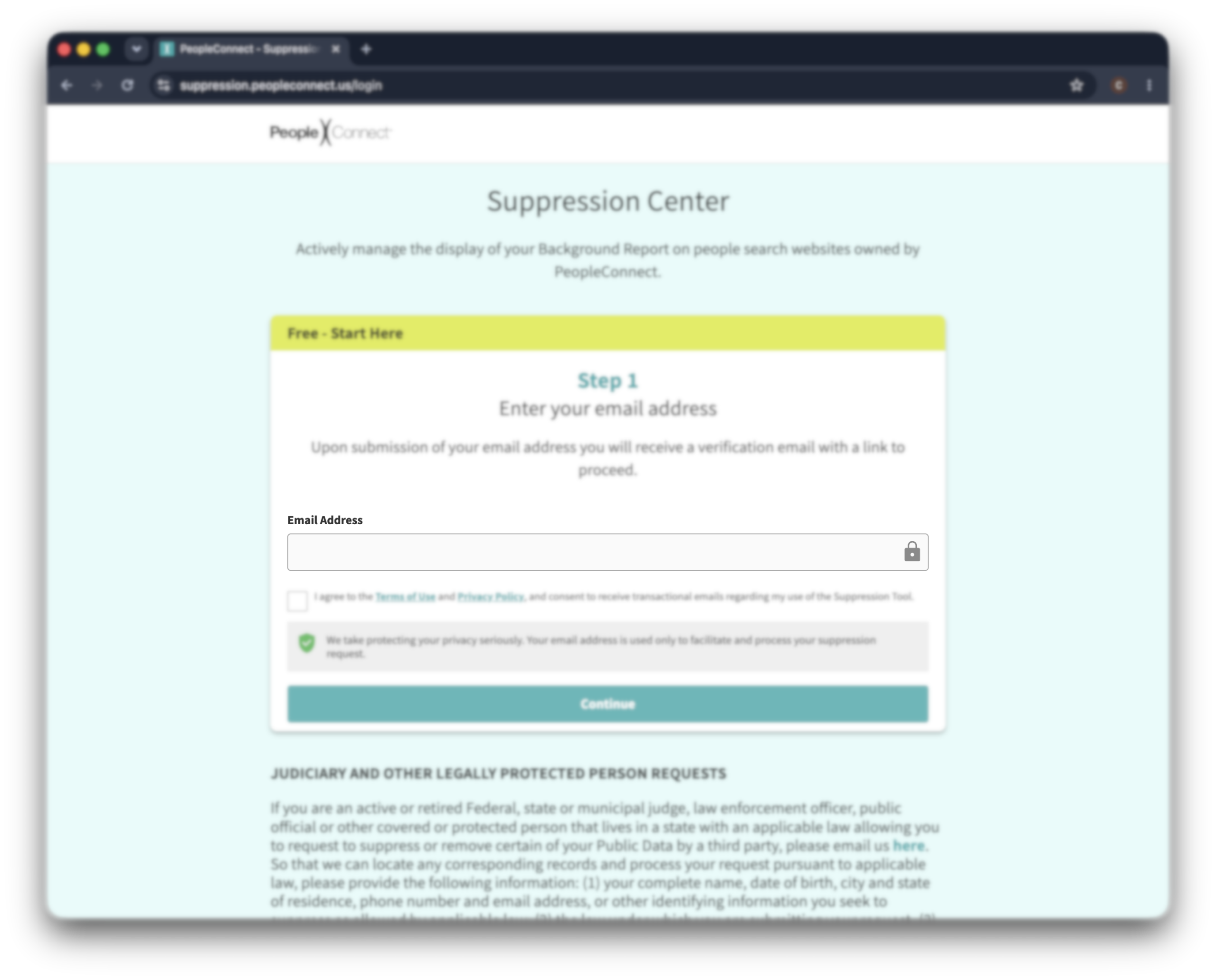
Enter your email, check the box to accept the terms, and submit.
PeopleConnect sends you a verification link. Open it and click through.
Do this quickly. The link dies after about 15 minutes. And use an inbox you can open right now, because nothing moves until you click it. -
Confirm your date of birth and name
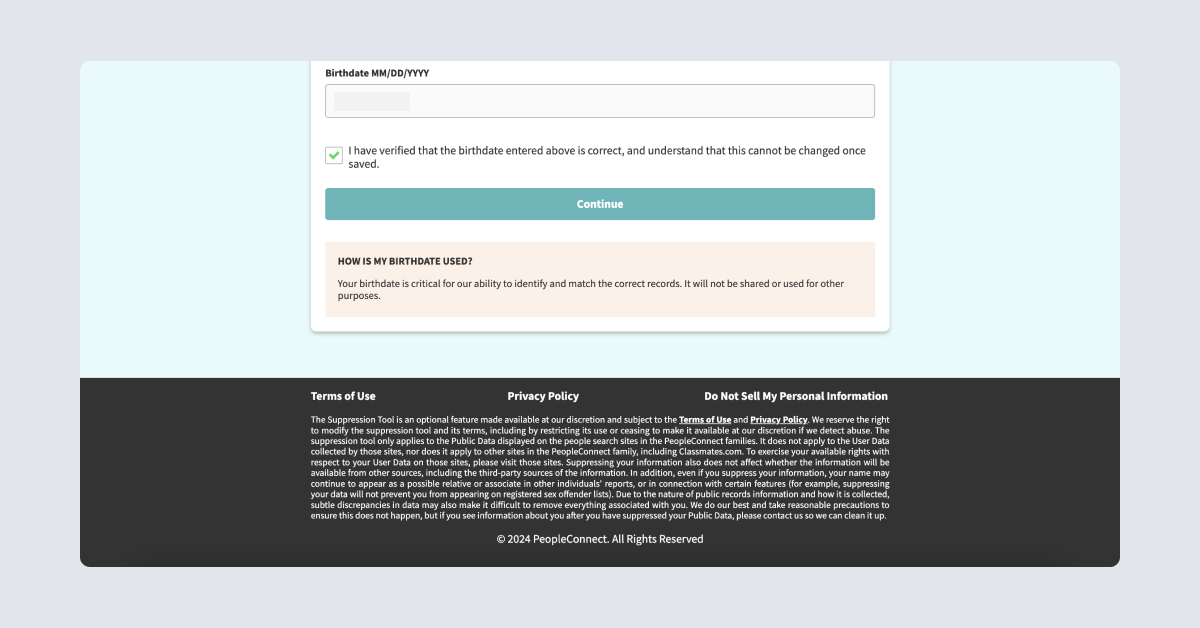
Confirm your date of birth, click “continue,” and type in your full legal name.
The Suppression Center searches its database and shows you the records that match.
-
Select your record
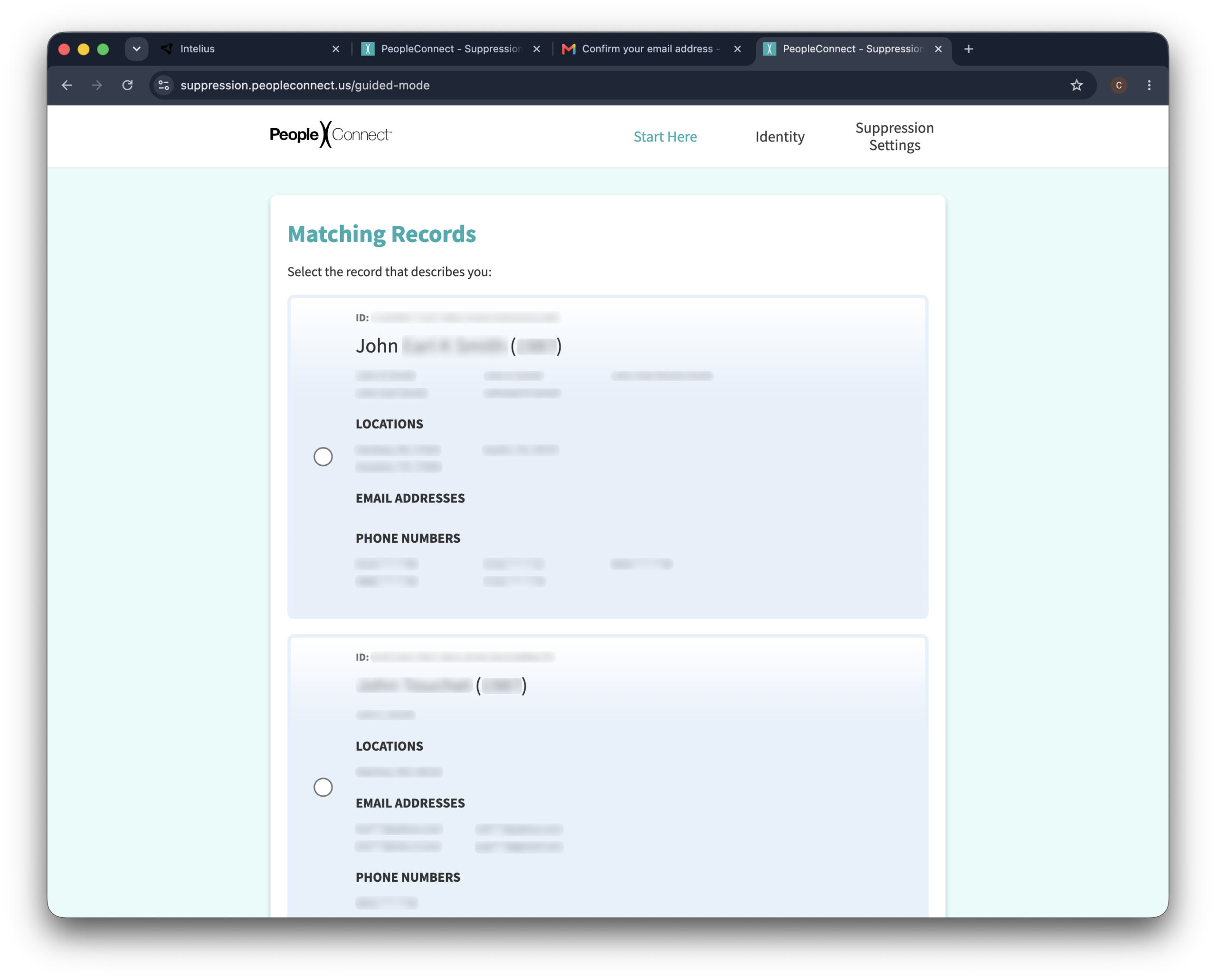
Read the results before you do anything.
There’s often more than one near-match. Check the age, the city, the relatives listed. You only want the record that’s actually you.
Select it and continue.
-
Verify your identity with a code
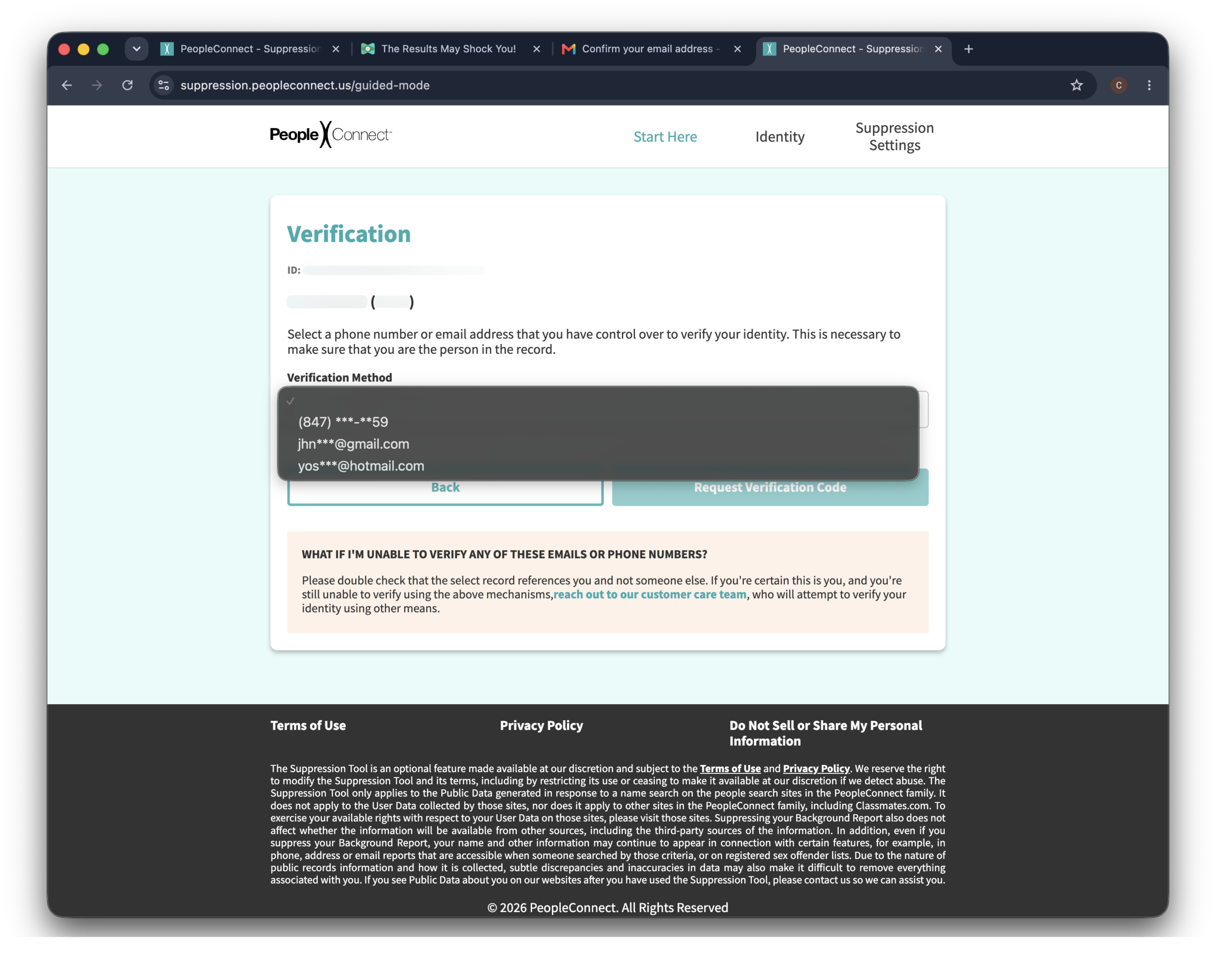
PeopleConnect won’t suppress anything until you prove the record belongs to you. It pulls up the email addresses and phone numbers attached to that listing and asks you to choose one for a verification code.
Choose an email or phone number you can actually access, then request the code. It arrives by email or text—enter it to confirm.
Here’s the catch—
The only options are the contact details already on the record. If they’re all old, you’re stuck. Skip to the email or phone route below and ask a rep to handle it. -
Set your record to suppressed
Once you’re verified, open the “desired behavior” setting, choose “suppressed,” and click “save.”
A confirmation appears on screen. Screenshot it or note the date. That’s your proof if the listing ever comes back.
Alternative opt-out methods
Reach for these when the form rejects you, the code can’t get to you, or you just want the request in writing.
Email [email protected] ([email protected] works as a backup).
Say clearly that you want your TruthFinder listing suppressed, and give them enough to find your record.
You can use the template from the Intelius opt-out guide.
Phone
Call Intelius customer care at (877) 564-3253.
Hours are Monday to Friday, 7:00 a.m. to 4:00 p.m. Pacific time.
Tell the rep you want to opt out and suppress your data—not cancel a subscription.
Have your name, date of birth, and the addresses tied to the listing ready so they can find and verify your record.
Opting out vs canceling your subscription
This is where people get caught.
TruthFinder pushes its paid memberships hard, so it’s easy to assume that canceling wipes your data too.
It doesn’t.
Cancel, and the charges stop. Your listing stays right where it was, searchable by anyone.
To come off the site, you run the suppression steps above. If you’ve also got an active membership, cancel that on its own.
Put simply: canceling handles your wallet. Suppression handles your privacy.
What to expect after opting out
In short: TruthFinder usually processes a confirmed suppression in about 48 hours, and because it runs on PeopleConnect, the same request clears Intelius, Instant Checkmate, and US Search too. Google may keep showing the old page for a few more days until it re-crawls.
Give it two days.
Some records drop faster, but 48 hours is TruthFinder’s window—and there’s no email telling you it’s done. You have to check yourself.
Then go look.
Clear your cache, search your name on truthfinder.com, and see if the listing’s gone. If it is, you’re off. Keep that confirmation screenshot anyway.
Suppressed isn’t deleted.
Worth being clear on this: the Suppression Center hides your record from name searches. It doesn’t wipe the underlying data. The court filings, property records, and voter rolls behind it all stay put.
One request, four sites.
Since TruthFinder shares the Suppression Center with Intelius, Instant Checkmate, and US Search, that single opt-out covers all four. That’s the payoff of a shared hub.
But—
It won’t last forever. PeopleConnect keeps pulling from public records and commercial feeds, so a new listing can surface later as those sources refresh. Your opt-out worked. It’s the fresh data that brings you back.
Troubleshooting
In short: Most TruthFinder opt-out trouble comes down to three things: the verification email or code never shows up, the search finds nothing, or the listing returns weeks later. None of them means your request failed.
The email or code never showed up
Check spam and promotions first, and search your inbox for “PeopleConnect.”
Nothing there? The email link only lasts about 15 minutes, so it may have timed out—start over at suppression.peopleconnect.us and use a personal address like Gmail or Outlook, which slips past corporate filters more often than a work account. If it’s the verification code that won’t come, the next item is for you.
The code can only reach an old email or phone
This one frustrates a lot of people. When you hit the identity check, the only contact options are an email or number you haven’t touched in years.
No code means no finished form. Drop the online route and email [email protected], or call (800) 699-8081, with your name, date of birth, and the addresses on the listing. Ask them to verify and suppress it for you.
The search finds nothing
Try your name a few ways—with the middle name, then without—and double-check your date of birth.
Records sometimes sit under a maiden name or an old address. Still empty? Hand it to a rep through the email or phone route and let them dig.
The listing came back
A record that returns weeks or months later almost always means PeopleConnect re-collected your data from a fresh public-records pass. It doesn’t mean your first request was rejected.
Run the suppression again. And if the same listing keeps coming back, that’s your sign that doing this by hand isn’t a fight you’ll win.
It still shows up on Google
Google keeps its own cache on its own schedule. Your TruthFinder page can be gone from the site but still appear in search for a few days. To speed it up, send the URL to Google’s Remove Outdated Content tool once the page returns a 404.
Other data brokers that may have your info
TruthFinder didn’t create your data. It bought it.
The same name, address, and phone records behind your TruthFinder listing are sitting on Spokeo, AnyWho, Whitepages, and dozens more.
Every one of them has its own opt-out. And most put your data back within a few months.
You can work through them yourself with our broker-specific guides for Intelius, AnyWho, and Spokeo.
Or—
Hand off the whole job.
The PeopleConnect opt-out clears four sites at once, but the rest of the market won’t bundle for you. You’d be re-filing the same request, codes and all, every time a listing crept back.
Incogni covers 420+ similar data brokers, sends the opt-outs for you, and files them again whenever your data turns up.
FAQ
Why should I opt out of TruthFinder?
Because for a few dollars, anyone—an ex, a stranger, a scammer—can pull up your address, phone number, age, and relatives in one search. Opting out shrinks that exposure and makes you a harder target for stalking, doxxing, and identity theft. It won’t erase you from the internet, but it shuts one of the easiest doors.
Why is my info on TruthFinder?
Because TruthFinder collects it from public records and commercial data, then republishes it. Property records, voter registrations, court filings, marketing data—any of them can put your name, age, address, phone number, and relatives on the site. Nobody asked you, and nobody told you.
Can someone tell if you looked them up on TruthFinder?
No. TruthFinder doesn’t notify anyone when their name is searched, and lookups are anonymous to the person being searched. Just keep in mind the reverse is true for you too—and that TruthFinder’s terms bar using reports for hiring or tenant screening, since it isn’t an FCRA-compliant background-check provider.
Is it hard to cancel TruthFinder?
Canceling is easy—call member care at (855) 921-3711 during Pacific business hours and the charges stop. The trap is thinking that’s the end of it. A canceled membership leaves your public listing fully intact, so if privacy is the real goal, treat canceling and suppressing as two separate jobs.
Does TruthFinder use your information?
Yes, TruthFinder uses your information. The whole business model of data brokers like TruthFinder revolves around collecting data on often unsuspecting people and then selling access to that data to anyone willing and able to pay. Use our guide to opt out of TruthFinder and put a stop to this.