Stop spam > Stop spam calls > Why do random numbers call me?
Why do random numbers call me?
If you receive calls from random phone numbers or calls that ring only once and hang up, then your number is probably on a scammer’s hit list.
Read on to learn why random numbers call you, why you should not answer calls from random numbers, what to do if you receive a scam call, and how to reduce the number of scam calls in a lasting way.

Updated on: 29 September, 2026
In short:
The reason you receive so many calls from random numbers is that your phone number is widely accessible. It’s highly likely that your personal information has been exposed in a data breach. Even if it hasn’t, your number is listed on data broker sites and people search websites. Scammers and telemarketing companies use automated systems to dial random or sequentially generated phone numbers to promote their products or services.
That’s it really. But there is a lot you can do to stop this
What to do if random numbers call you:
1) Remove your phone number from the internet
Scammers, spammers, and telemarketers call you in part because it’s easy for them to find your phone number online. Even if you didn’t leave it on social media sites when creating your profile, it’ll pop-up next to your name on people search sites.
One of the best ways to lower the volume of spam, scams, and robocalls heading your way is to remove your personal information from the internet. Start by opting out from data brokers. You can do this on your own, but given the number of people search sites and data brokers that hold your data, it’ll take a massive chunk of your time.
You can also let others do it for you. A data removal service like Incogni will send removal requests to the 420+ data brokers it covers and will continue doing so on a regular basis to keep your record clean.
2) Use throwaway, single-use phone numbers
Another great practice is to use temporary phone numbers when signing up for accounts online. A phone number is usually required whenever you create an account online. A throwaway number is a great way to receive a verification code, as that’s usually all you need to use it for. You can discard it afterward to avoid getting spam calls.
The same can be done with your email address. Click through for a recap of the best disposable email services.
3) Take the necessary steps to stop spam calls
We wrote several guides on stopping spam calls. Here is an overview:
4) Report scam and spam calls
Don’t let fraudsters get away with scam calls, even if they are “just” a nuisance. You can report unwanted calls to the Federal Trade Commission’s (FTC’s) registry. Go to https://www.donotcall.gov/ and select “report unwanted calls.”
If a phone call caused you to lose money, go directly to https://reportfraud.ftc.gov/#/ to report fraud.
If you receive a threatening or harassing call on a landline, dial *57 immediately afterward to trace the call. Your phone service provider will try to trace the number. You’ll then need to report the incident to the police—the phone service provider will disclose the caller ID to them.
Should you answer random calls?
It’s best not to answer calls from random numbers. By random, we mean numbers that neither you nor your phone recognize. These are either “no caller ID calls,” unknown callers, private numbers, restricted numbers, or numbers not in your contact list.
And if you do, don’t speak first
Don’t speak. If you decide to pick up a random call, do not say anything; listen and wait for them to talk first. Some scammers record the conversation and try to gather additional information about you this way.
Related: what happens if you answer a spam call, including voice cloning and the “can you hear me” consent trick.
What are the risks of picking up from random numbers?
Yes, it could be a recruiter with a job offer or an old friend, but sadly, in the majority of cases, you’re exposing yourself to one of the following:
- A potential scam: An attempt to scam you out of money.
- Spam calls: Where callers try to sell you something you neither need nor want.
- Robocalls: Pre-recorded spam or scam messages.
- Identity theft: Scammers may use random calls to gather personal information that can be used for identity theft.
- Potential financial loss: Including unauthorized charges on your accounts.
- Social engineering attacks: Scammers may manipulate you into disclosing sensitive information or performing actions against your best interest.
- And last but not least: Stress, anxiety, and wasted time.
Which techniques do scammers use to contact you?
In short:
Scammers use deceptive tactics to drive record fraud. They spoof familiar numbers like local area codes, your own phone, or stolen contacts. They also mask caller IDs or use one-ring calls to trick you into calling back.
The Federal Trade Commission’s Consumer Sentinel Data Book shows that about $16 billion was reported lost to fraud in 2025—the highest figure on record, and roughly 25% more than the year before. Imposter scams alone accounted for $3.5 billion of that, and were the single most reported category.
In other words, scammers are getting more sophisticated and managing to get away with fraud more often. How do they do it? Here are some of the most common methods they use.
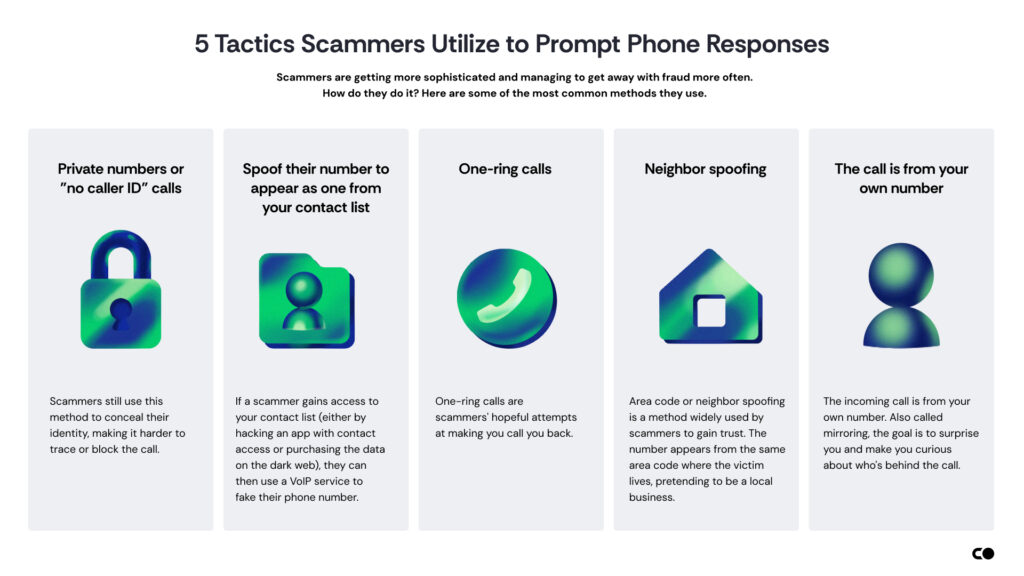
The call is from your own number: Another type of caller ID spoofing leads to the incoming call looking like it’s come from your own number. Also called mirroring, the goal is to surprise you and make you curious about who’s behind the call.
Private numbers, restricted numbers or “no caller ID”: scammers still use this method to conceal their identity, making it harder to trace or block the call.
Spoof their number to appear as one from your contact list: scammers can steal your contact lists by, for example, breaching an application with access to it. Or, if they have the means, they can buy this data on the dark web. Once in possession of a list of numbers the target will recognize, it’s easy for scammers to make the victim pick up their phone.
One-ring calls: scammers use this technique to make you call them back. The phone rings once and the number (often spoofed to hide an international number) is registered by your phone.
Neighbor spoofing: area code or neighbor spoofing is a method widely used by scammers to gain trust. The number appears to come from the same area code where the victim lives, pretending to be a local business. To learn more about area code spoofing, read our research article, in which we demonstrate that the majority of spam and scam numbers appear to originate from your county or state.
Why you are experiencing sudden spikes in weekly spam calls
In short:
Spam call spikes stem from data breaches, dark web sales, or data brokers trading your profile. “Ping” calls test if your line is active, driving more calls if confirmed. Spikes can also follow seasonal events or someone deliberately signing you up.
Spam calls tend to arrive at a fairly steady background rate. If yours jumped suddenly rather than creeping up over months, there is usually a specific reason behind it.
Your phone number was leaked in a data breach
A sudden uptick often follows a breach at a company you gave your number to. Breached databases get passed around quickly, and phone numbers are among the more useful fields in them.
Checking is less straightforward than it sounds. Have I Been Pwned is the usual starting point, but its website search only accepts an email address—phone numbers can’t be searched there. Search the email address tied to the account instead, then check whether the breach it turns up also exposed phone numbers.
If you find yourself on a breach list, secure the affected accounts first: change passwords to something long and unique, and enable two-factor authentication wherever it is offered.
Your phone number is being sold in scammer groups
Whether your data was compromised in a breach, bought by the wrong people, or scraped from public sources, it may have found its way onto the dark web. Cybercriminals often sell large datasets containing contact details, account credentials, and more to other bad actors in bulk.
Related: what to do if your number is found on the dark web.
Automated ping calls are confirming your number is live
The one-ring calls described above are trying to get you to call back. Ping calls look much the same from your side, but the purpose is different.
Spammers run automated dialers through thousands of numbers in sequence to see which ones connect. The call often lasts a second, or drops before you can answer, because reaching you was never the point—logging your number as active is.
A number that has been confirmed as live is worth more than an untested one, so it gets resold and reused in later campaigns. Answering, or calling back a missed ping call, confirms the line is live.
The calls are following the calendar
Some spikes are seasonal rather than personal. Medicare open enrollment runs from mid-October to early December, and the health insurance marketplace window follows over the winter. Both bring a surge in insurance sales calls, legitimate and otherwise.
Tax season does much the same for IRS impersonation scams in the spring. If your spike lines up with one of these windows, it may well ease off on its own. Related: how to stop health insurance calls and how to stop Medicare calls.
Someone signed you up for spam calls
It is more common than you might think for someone to deliberately sign another person’s number up for marketing lists, usually after a personal dispute. If the calls started right after a falling-out, this may be the cause.
There is not much to undo here. Most of these signups go through legitimate marketing forms, so there is no single place to report or reverse them, and the blocking tools above are the practical response.
Data brokers are compiling and reselling your profile
Data brokers and people search sites collect your phone number along with a wide range of other details, then compile and sell profiles to marketers and, in documented cases, to fraudsters.
The FTC has brought cases against data brokers for exactly this. In one, a broker sold payday loan applications—each containing the applicant’s name, address, phone number, Social Security number, and bank details—to buyers it knew were not lenders, and scammers used them to drain accounts.
Because brokers pull from so many sources and resell continuously, removing your data once does not hold. That is why removing your number from broker lists is the first step in this guide rather than the last.
How to report spam calls
Reporting rarely stops the calls you are already getting. What it does is feed the FTC’s enforcement work, which is how illegal callers eventually get shut down.
There are three circumstances in which you should report spam calls to the FTC:
- If you’ve signed up for the national Do Not Call registry and you’re still receiving telemarketing and other types of nuisance spam calls, you can report it to the FTC.
- If you receive robocalls, even if you haven’t signed up for the Do Not Call registry, you can also report those robocalls using the same portal.
- If the type of spam call you receive is fraudulent, you should report it to the FTC as well.
FAQ
Why do spam calls hang up?
It’s a common practice for spam and scam callers to call and hang up immediately. These one-ring calls are meant to pique your curiosity and make you return the call. The number is often spoofed, which means it appears to be local, but is actually a toll number.
Why is a private number calling me?
Individuals and companies use private numbers to conceal their identities. They are often used by medical facilities or law enforcement for legitimate reasons. However, the person hiding behind a private number could also be a scammer who wants to stay anonymous to avoid consequences.
Why can’t I call back a number that called me?
You won’t be able to call back a number if the caller ID is hidden, restricted, or private. Some people and institutions decide to conceal their numbers for privacy reasons. Scammers do this to avoid being called back and reported.
Why are random numbers texting me?
You’ll receive spam and scam texts if your phone number is on a telemarketing list or readily available online. A scam message usually contains a fraudulent link, inviting you to click and provide your credit card number or other personal information.
Why does “no caller ID” keep calling me?
Incessant calls from a “no caller ID” number should be reported as harassment. Contact the FTC’s Do Not Call registry to report the call, or dial *57 (on landline only) to request call tracing.
Should I be worried if I get a lot of spam calls?
Spam calls are very common, however, it may be cause for worry if you experience a sudden increase in the number of spam calls you get. This could indicate a deeper problem, such as a data breach affecting your accounts, rather than the normal background rate of spam.
Why do spammers call and not say anything?
Silent spam calls are usually telemarketing cold calls. This happens when the company uses predictive dialers which make many calls and sometimes do not have available agents to handle the call, resulting in a silent connection. It can also be an automated ping call confirming your number is active, as covered above.